Beacon
Beacon
Designing accessible onboarding system for blind and low-vision riders in autonomous vehicles
Best UX Design & Research capstone (1 of 150 teams) · CCAT finalist · Campus of the Future semifinalist
Company
Company
University of Michigan
University of Michigan
Timeline
Timeline
Winter 2026 (12 weeks)
Role
Role
Product Designer & Manager
Team
Team
Team of 5, advised by faculty for accessibility & haptics
Team of 5, advised by faculty for accessibility & haptics
Individual contribution
Individual contribution
Field research · Interaction design · Product Management
Team effort
Team effort
Competitive analysis · Strategic research · Stakeholder alignment

Overview
Autonomous vehicles could become one of the most independence-changing technologies for blind & low-vision (BLV) riders.
Autonomous vehicles could become one of the most independence-changing technologies for blind & low-vision (BLV) riders.
Research shows that 88% of blind people believe AVs will transform their independence, and yet the services available today offer almost no accessible way to begin a ride. You can book the car, but after that you are on your own to locate a vehicle on a busy street, get in without a driver to ask, and trust a machine to start moving.
Research shows that 88% of blind people believe AVs will transform their independence, and yet the services available today offer almost no accessible way to begin a ride. You can book the car, but after that you are on your own to locate a vehicle on a busy street, get in without a driver to ask, and trust a machine to start moving.

Fuzzy Problem
HMW build trust with blind & low-vision riders so they can confidently use autonomous vehicles?
HMW build trust with blind & low-vision riders so they can confidently use autonomous vehicles?
Consulting UMTRI, an engineer at GM, and mobility-innovation experts, I found that the physical layer, like ramps and modified doors, is already well researched. The less obvious gap was perception. Autonomous vehicles remove the driver, who is usually the person a rider counts on to confirm the car is theirs and safe to enter, so asking who loses the most when those cues disappear led us to blind and low-vision riders.
Consulting UMTRI, an engineer at GM, and mobility-innovation experts, I found that the physical layer, like ramps and modified doors, is already well researched. The less obvious gap was perception. Autonomous vehicles remove the driver, who is usually the person a rider counts on to confirm the car is theirs and safe to enter, so asking who loses the most when those cues disappear led us to blind and low-vision riders.
A service can be fair without being usable, and that was a gap that was easy to miss because no one was measuring it

Research
Expert, Rider, & Real-World Perspectives.
Expert, Rider, & Real-World Perspectives.
We built our understanding from three directions at once. I interviewed researchers at the intersection of blindness and mobility, several of whom are BLV themselves, plus an AI/ML lead at General Motors to pressure-test what the industry was actually building.
We built our understanding from three directions at once. I interviewed researchers at the intersection of blindness and mobility, several of whom are BLV themselves, plus an AI/ML lead at General Motors to pressure-test what the industry was actually building.

Dr. Paul
"Autonomy means independence and not relying on people. It can be life changing. Learning is an important piece, and how to design things to help people learn."
Prof. Sile
"Haptics are tricky. People have to be trained. The safer thing to do is speech and audio. More obvious and less intrusive is best."
I ran user interviews with BLV riders. Where the researchers brought expertise, Sam and Andrea brought the unfiltered reality of being a rider.
I ran user interviews with BLV riders. Where the researchers brought expertise, Sam and Andrea brought the unfiltered reality of being a rider.
Sam
"If a vehicle doesn't pull up right in front of me, figuring out where that vehicle has arrived is a challenge."
Andrea
"I would use it in a heartbeat." (on wrist haptics, because she only has one free hand as a guide dog user)
Field Test
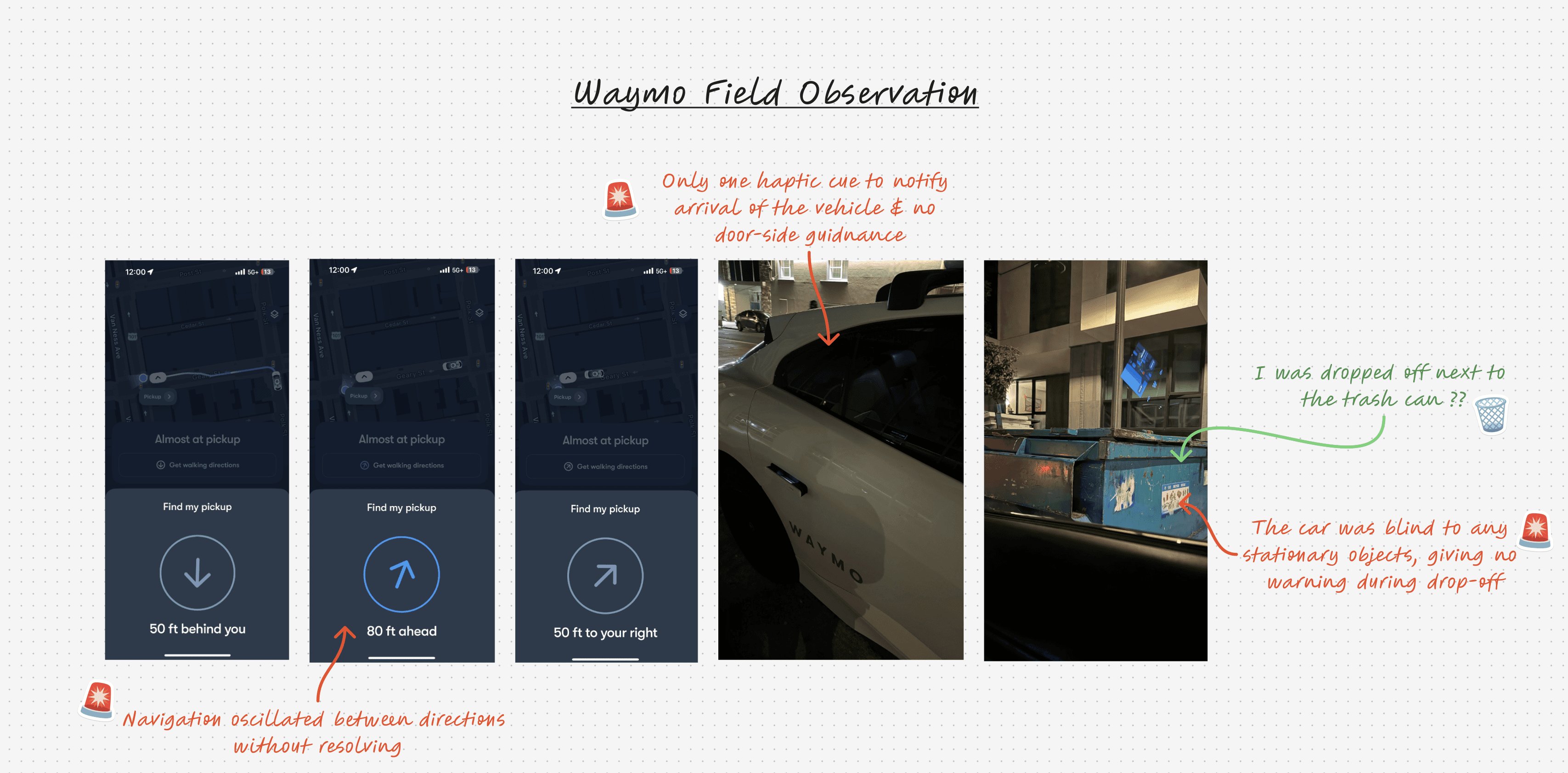
I ran a field test in San Francisco, riding Waymo as a simulated novice BLV rider.
I ran a field test in San Francisco, riding Waymo as a simulated novice BLV rider.
These findings, combined with three expert interviews and our user conversations, became the design principles behind every concept that followed.
These findings, combined with three expert interviews and our user conversations, became the design principles behind every concept that followed.
When things became less fuzzy
Closing the perception gap.
Closing the perception gap.
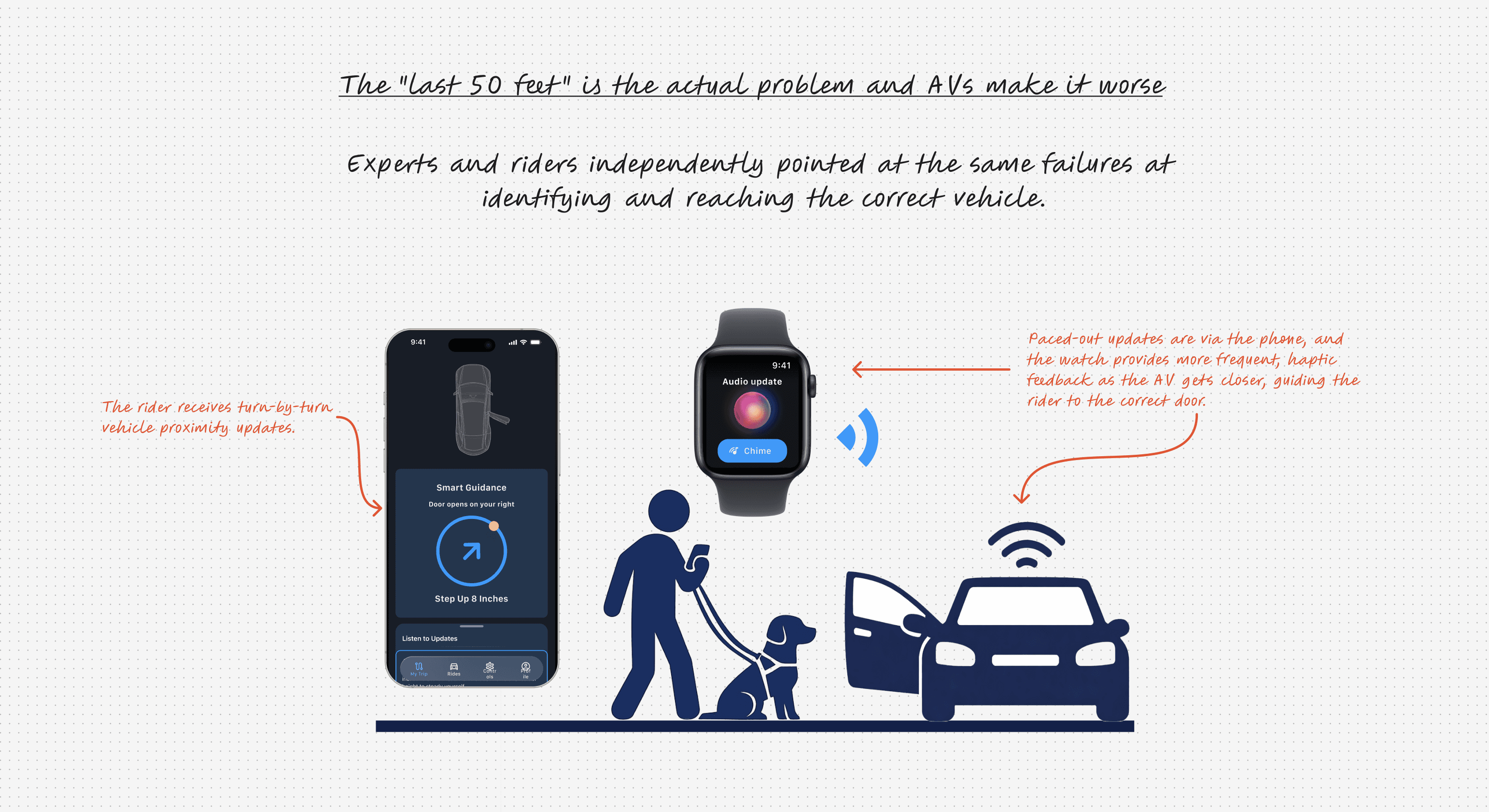
Driverless services like Waymo or May Mobility focus on their work that lives inside the ride. When speaking with riders and researchers, the hardest part of the trip was before the trip even begins.
Pain points include locating the right vehicle among parked cars, approaching it safely, finding a flush door handle, getting a guide dog settled, and confirming that this is the right vehicle.
An inclusive onboarding experience that closes the perception gap at pickup, giving BLV riders the spatial awareness to confidently locate, approach, and board an autonomous vehicle
Driverless services like Waymo or May Mobility focus on their work that lives inside the ride. When speaking with riders and researchers, the hardest part of the trip was before the trip even begins.
Pain points include locating the right vehicle among parked cars, approaching it safely, finding a flush door handle, getting a guide dog settled, and confirming that this is the right vehicle.
An inclusive onboarding experience that closes the perception gap at pickup, giving BLV riders the spatial awareness to confidently locate, approach, and board an autonomous vehicle

From research to design
The hardest moments are the last few feet. I found 5 insights that helped reframe the project.
The hardest moments are the last few feet. I found 5 insights that helped reframe the project.


Solution
I translated the research into a set of goals for me to design within them.
I translated the research into a set of goals for me to design within them.
Crucially, our interviewees reminded us to design for the whole technology spectrum as much of the BLV community is elderly or on older hardware. Therefore, the baseline had to work on a basic phone (haptics + gyroscope), with the Apple Watch as an enhancement, not a requirement.
Crucially, our interviewees reminded us to design for the whole technology spectrum as much of the BLV community is elderly or on older hardware. Therefore, the baseline had to work on a basic phone (haptics + gyroscope), with the Apple Watch as an enhancement, not a requirement.
Phone UI
Welcome Rider
Learn how pickup guidance works
Order and Wait
Request your ride & confirm pickup
Looking for Vehicle
Locate your arriving vehicle confidently
Getting into the AV
Safely onboard into your vehicle
Welcome Rider
Learn how pickup guidance works
Order and Wait
Request your ride & confirm pickup
Looking for Vehicle
Locate your arriving vehicle confidently
Getting into the AV
Safely onboard into your vehicle
Welcome Rider
Learn how pickup guidance works
Order and Wait
Request your ride & confirm pickup
Looking for Vehicle
Locate your arriving vehicle confidently
Getting into the AV
Safely onboard into your vehicle
Welcome Rider
Learn how pickup guidance works
Order and Wait
Request your ride & confirm pickup
Looking for Vehicle
Locate your arriving vehicle confidently
Getting into the AV
Safely onboard into your vehicle
Welcome Rider
Learn how pickup guidance works
Order and Wait
Request your ride & confirm pickup
Looking for Vehicle
Locate your arriving vehicle confidently
Getting into the AV
Safely onboard into your vehicle
Welcome Rider
Learn how pickup guidance works
Order and Wait
Request your ride & confirm pickup
Looking for Vehicle
Locate your arriving vehicle confidently
Getting into the AV
Safely onboard into your vehicle
Welcome Rider
Learn how pickup guidance works
Order and Wait
Request your ride & confirm pickup
Looking for Vehicle
Locate your arriving vehicle confidently
Getting into the AV
Safely onboard into your vehicle
Welcome Rider
Learn how pickup guidance works
Order and Wait
Request your ride & confirm pickup
Looking for Vehicle
Locate your arriving vehicle confidently
Getting into the AV
Safely onboard into your vehicle
Watch UI
Welcome Rider
Learn how pickup guidance works
Order and Wait
Request your ride & confirm pickup
Looking for Vehicle
Locate your arriving vehicle confidently
Getting into the AV
Safely onboard into your vehicle
Welcome Rider
Learn how pickup guidance works
Order and Wait
Request your ride & confirm pickup
Looking for Vehicle
Locate your arriving vehicle confidently
Getting into the AV
Safely onboard into your vehicle
Welcome Rider
Learn how pickup guidance works
Order and Wait
Request your ride & confirm pickup
Looking for Vehicle
Locate your arriving vehicle confidently
Getting into the AV
Safely onboard into your vehicle
Welcome Rider
Learn how pickup guidance works
Order and Wait
Request your ride & confirm pickup
Looking for Vehicle
Locate your arriving vehicle confidently
Getting into the AV
Safely onboard into your vehicle
Welcome Rider
Learn how pickup guidance works
Order and Wait
Request your ride & confirm pickup
Looking for Vehicle
Locate your arriving vehicle confidently
Getting into the AV
Safely onboard into your vehicle
Welcome Rider
Learn how pickup guidance works
Order and Wait
Request your ride & confirm pickup
Looking for Vehicle
Locate your arriving vehicle confidently
Getting into the AV
Safely onboard into your vehicle
Welcome Rider
Learn how pickup guidance works
Order and Wait
Request your ride & confirm pickup
Looking for Vehicle
Locate your arriving vehicle confidently
Getting into the AV
Safely onboard into your vehicle
Welcome Rider
Learn how pickup guidance works
Order and Wait
Request your ride & confirm pickup
Looking for Vehicle
Locate your arriving vehicle confidently
Getting into the AV
Safely onboard into your vehicle
Welcome Rider
Learn how pickup guidance works
Order and Wait
Request your ride & confirm pickup
Looking for Vehicle
Locate your arriving vehicle confidently
Getting into the AV
Safely onboard into your vehicle
Welcome Rider
Learn how pickup guidance works
Order and Wait
Request your ride & confirm pickup
Looking for Vehicle
Locate your arriving vehicle confidently
Getting into the AV
Safely onboard into your vehicle
Welcome Rider
Learn how pickup guidance works
Order and Wait
Request your ride & confirm pickup
Looking for Vehicle
Locate your arriving vehicle confidently
Getting into the AV
Safely onboard into your vehicle
Welcome Rider
Learn how pickup guidance works
Order and Wait
Request your ride & confirm pickup
Looking for Vehicle
Locate your arriving vehicle confidently
Getting into the AV
Safely onboard into your vehicle
Welcome Rider
Learn how pickup guidance works
Order and Wait
Request your ride & confirm pickup
Looking for Vehicle
Locate your arriving vehicle confidently
Getting into the AV
Safely onboard into your vehicle
Welcome Rider
Learn how pickup guidance works
Order and Wait
Request your ride & confirm pickup
Looking for Vehicle
Locate your arriving vehicle confidently
Getting into the AV
Safely onboard into your vehicle
Welcome Rider
Learn how pickup guidance works
Order and Wait
Request your ride & confirm pickup
Looking for Vehicle
Locate your arriving vehicle confidently
Getting into the AV
Safely onboard into your vehicle
Welcome Rider
Learn how pickup guidance works
Order and Wait
Request your ride & confirm pickup
Looking for Vehicle
Locate your arriving vehicle confidently
Getting into the AV
Safely onboard into your vehicle
Reflection
Rigor is empathy.
Rigor is empathy.
Both blind researchers we spoke to warned us that a sighted person in a blindfold is not a blind rider with different mental models, residual vision, and a fundamentally different relationship to risk. That reframed how I worked. The most valuable design decisions in this project came from listening closely enough that the riders' constraints became brief.
The designer is never the user. In accessibility, that gap is the whole problem, so I closed it with rigor instead of pretending to bridge it with empathy. This project turned a space no one on the team had lived in into a scoped problem, a clear point of view, and two testable concepts by letting the people who live in it lead.
Both blind researchers we spoke to warned us that a sighted person in a blindfold is not a blind rider with different mental models, residual vision, and a fundamentally different relationship to risk. That reframed how I worked. The most valuable design decisions in this project came from listening closely enough that the riders' constraints became brief.
The designer is never the user. In accessibility, that gap is the whole problem, so I closed it with rigor instead of pretending to bridge it with empathy. This project turned a space no one on the team had lived in into a scoped problem, a clear point of view, and two testable concepts by letting the people who live in it lead.